
Victorian Nursery Tiles
It is the childlike part of us that produces works of the imagination. When we were children time passed so slow with us that we seemed to have time for everything. —William Morris
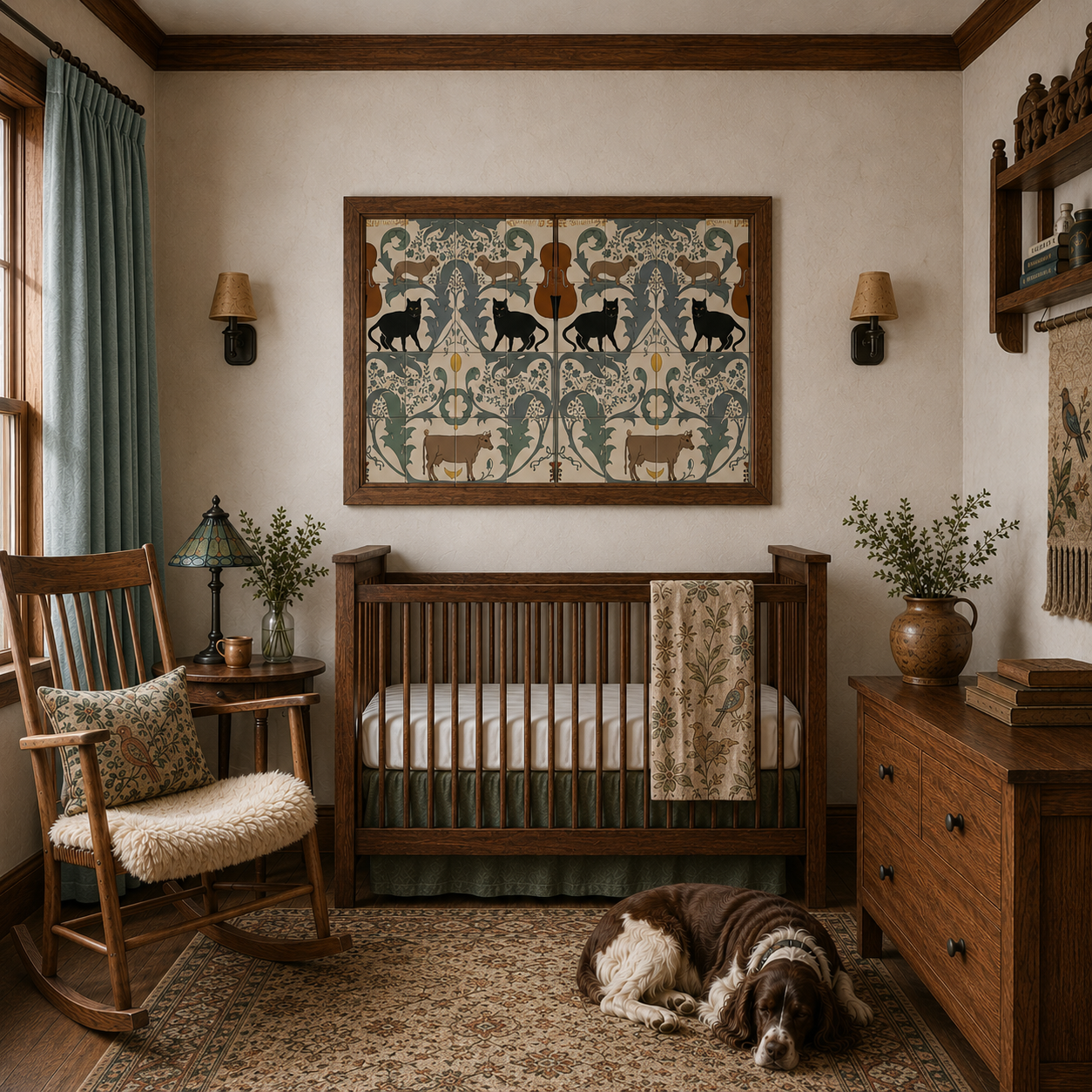
The Victorian Nursery
Like many Victorian parents, Voysey took his job as a parent as a God-given trust: He believed that what a child sees in those early years goes into the child — not as a theory, but as a conviction — and that the domestic room was therefore a serious training ground. Victorians cherished the concept of a childhood of innocence, as you can hear in the Morris quote above. Yet the childhood for most Victorian children was closer to an occupation: The work of a child was to grow up, to become a God-fearing and productive member of society. Working class children were assigned a trade early on and were often competent before reaching puberty. Upper class children had it little better: A series of nannies, tutors, and private schools. The finer things were indeed a requirement: A young lady should be able to play a musical instrument, be competent in drawing, her handwriting must be both legible and beautiful.
By most accounts, C.F.A. Voysey was a severe man, doctrinaire about his faith and uneasy with the wave of socialism that ran through the Arts & Crafts movement, a wave that William Morris himself had set in motion. Voysey’s tiles for children appear warmer than he was and yet, for his own nursery, he chose Rook and Holly — somber, serious tile, more Victorian Gothic in tone than Arts & Crafts.
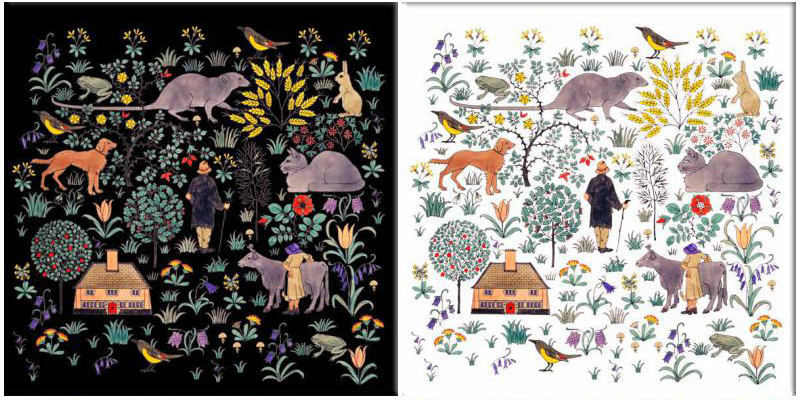
The design was not chosen out of mere temperament, however. Featuring three blackbirds perched in a bare winter tree with holly sprigs, Rook and Holly is emblematic of Voysey’s own early life, shaped by his father’s public heresy trial and loss of an ecclesiastical living.
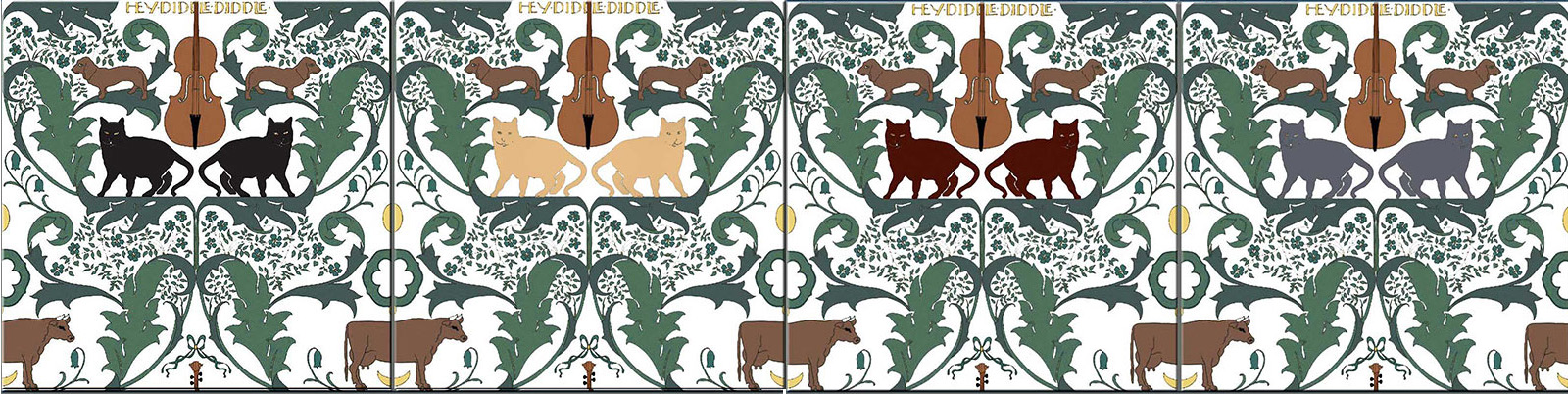
In contrast, the more popular Hey Diddle Diddle is a classic Victorian nursery style that actually predates Voysey by centuries. Indeed, the image was made for his hand: a cow in silhouette against a moon, flat and clear, the kind of shape that reads from across a nursery and stays.
Hey Diddle Diddle — cat lady variations, four colorways
CFA Voysey: Rook and Holly

Rook and Holly
Other Victorian Nursery Tiles
Aesop’s Fables
Edward Detmold illustrated many of Aesop’s Fables, well known to Victorians, children and adults alike.
See all the Aesop’s Fables tiles

Alice in Wonderland
CFA Voysey designed tiles based on Lewis Carroll’s Alice in Wonderland, produced by Victorian tilemaker Minton Co.
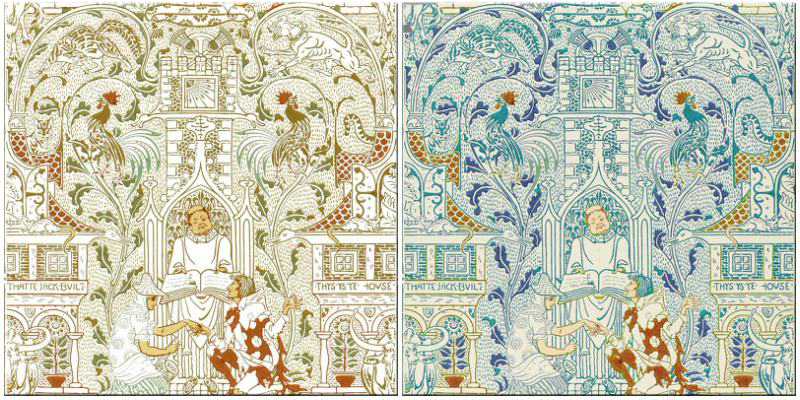
CFA Voysey: The House That Jack Built
Based on the CFA Voysey textile of the same name. Available on 6 inch tiles, black or white background.
Walter Crane: The House That Jack Built
Crane’s ornate Victorian version, first illustrated in 1865. Available on 6 inch and 8 inch tiles.
Pricing
Walter Crane and CFA Voysey Tiles
Six-inch: $68 each
Eight-inch: $88 each
For pricing and specifications of other tiles, please follow the link to their dedicated page.
Arts & Crafts Nursery Tiles

Burne-Jones Fairy Tale Story Tiles
Edward Burne-Jones designed 21 two-tile panels:
Overview of the Fairy Tale Story Tiles
William De Morgan Fantastic Creatures
Lewis Carroll Fireplace Tiles
De Morgan's red lustre tiles, some Alice themed, designed for Lewis Carroll’s rooms at Christ Church, Oxford.
See the complete set of red lustre tiles
Fantastic Birds and Beasts
Over 30 De Morgan blue and white fantastic birds and beasts.
Medieval Bestiary Tiles
Dragons, unicorns, medieval dogs and cats. One set, the 15th century Bestiary of Anne Walsh is the only known children's bestiary.